
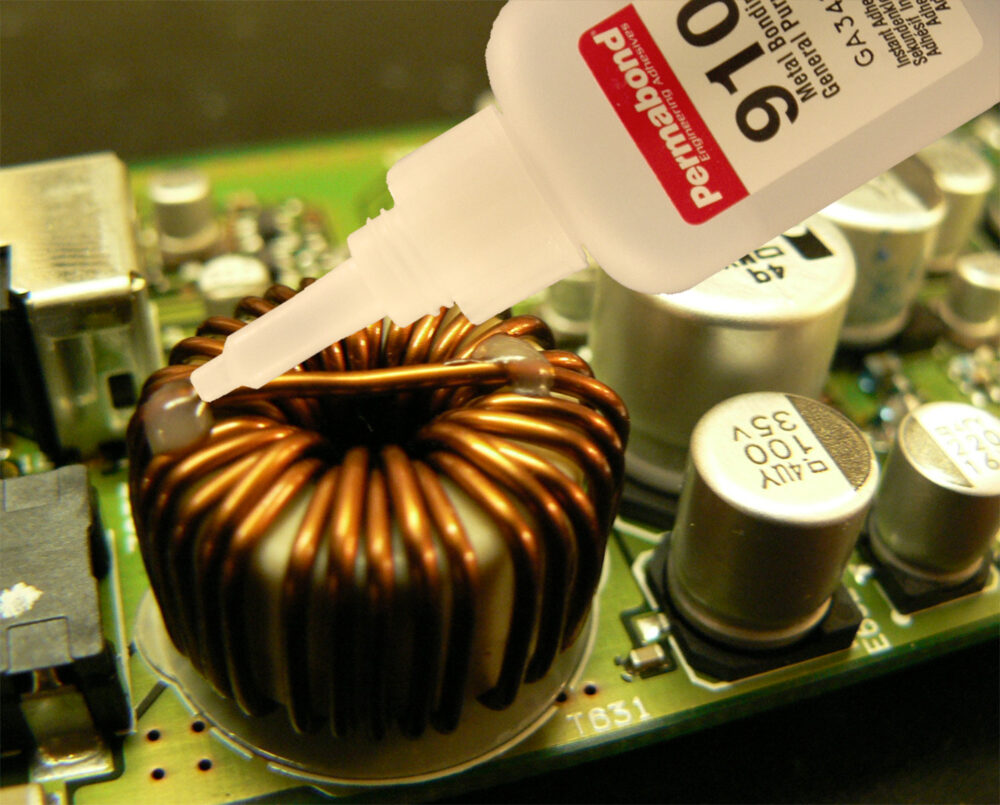
Permabond produces a wide range of industrial cyanoacrylate adhesives, also known as instant adhesives. These glues are highly popular, being able to bond many materials easily and reliably.
In chemistry terms, a cyanoacrylate is an acrylic monomer that cures into a plastic. Their standout feature is their incredibly fast cure speed, taking just seconds to set on a wide variety of materials. If you need a bonding job done fast, cyanoacrylates are a great place to start!
Chemically, cyanoacrylates differ from other adhesives in our range like epoxies and structural acrylics. Instead of relying on heat or an internal chemical reaction to cure, cyanoacrylate glues cure via a reaction with moisture, both on surfaces and in the air. This is what allows cyanoacrylates to bond to such a wide range of materials. If you’ve ever used a superglue before, you’ll notice it sticks to almost everything – this is why! Most surfaces, even if appearing dry, hold a microscopic amount of moisture captured from the surrounding air. This moisture is enough for a cyanoacrylate to cure.

A cyanoacrylate adhesive is the one type of glue you’re most likely to encounter at a store. They’re cheap, ubiquitous and what most people think of when they think of adhesives. But, while based on similar fundamental chemistry, industrial cyanoacrylates often differ from superglues you can pick up while out shopping.
Most consumer cyanoacrylates are based on ethyl cyanoacrylate, a versatile chemistry capable of rapidly bonding many common materials. Industrial cyanoacrylates may also be ethyl-based, but can also use different cyanoacrylate chemistries, such as methyl or alkoxy formulations, depending on the properties required. Methyl cyanoacrylates are great for bonding metals, for example, while alkoxy cyanoacrylates tend to have a lower odor than standard superglues.
More importantly, industrial products can be specially formulated to provide characteristics such as greater flexibility or toughness, improved temperature or chemical resistance, controlled viscosity, low odor and reduced blooming. This allows cyanoacrylate adhesives to be tailored to demanding applications far beyond the capabilities normally associated with household superglue. You can read more about Permabond’s range of specialty cyanoacrylate adhesives for such purposes below!
| Ethyl Cyanoacrylate | Methyl Cyanoacrylate | Alkoxy Cyanoacrylate | |
| Typical use | General-purpose bonding | More specialised bonding, particularly metals | Specialist low-odor/low-bloom bonding |
| Common substrates | Metals, plastics and rubbers | Particularly well suited to metals | Metals, plastics and rubbers |
| Key characteristics | Fast, strong and versatile | Hard, strong and rigid | Low odor and reduced blooming |
| Where found | Consumer and industrial adhesives | Mainly specialist/industrial adhesives | Mainly specialist/industrial adhesives |
| Why choose it? | Versatility | Rigid, high-strength bonds | Appearance and reduced odor |
Permabond has extensive history with cyanoacrylate adhesives. In fact, we still manufacture the very first patented cyanoacrylate ever made – Permabond 910! This methyl cyanoacrylate was invented in 1951 by Harry Coover Jr. while he was working as a chemist for Eastman Kodak. Released in 1958 as Eastman 910, its name comes from the fact that after counting to 9 or 10, the product cures to a solid. It swiftly became known as ‘superglue’ as people became aware of its amazing bonding properties. 
We’re incredibly proud to continue to manufacture Coover’s original cyanoacrylate. The formulation remains unchanged to this day, quite simply because it works so well! You can find out more about the fascinating history of this product here in Permabond 910: where it all started.
Cyanoacrylate adhesives are often chosen when a fast cure and easy application are priorities. Unlike many two-part structural adhesives, cyanoacrylates are typically single-part and cure quickly at room temperature, which allows bonded parts to be handled within seconds.
Cyanoacrylates provide high strength from a very small amount of adhesive and bond well to a wide variety of materials, including metals, plastics, rubbers and ceramics. This makes them particularly well suited for small components, close-fitting joints and high-speed production environments where fast cure and assembly is critical.
Cyanoacrylate adhesives can also be used as a temporary fixturing aid alongside slower-curing structural adhesives, such as epoxies. Small amounts of cyanoacrylate can be applied at selected points within or adjacent to the bond area, providing fast handling strength and holding components in position while the structural adhesive cures.
This can reduce or eliminate the need for clamps, jigs or other mechanical fixtures, helping to simplify assembly and improve production efficiency. Once fully cured, the structural adhesive provides the main strength and durability of the finished joint, while the cyanoacrylate has performed its role as a fast-setting assembly aid.
Since that original methyl cyanoacrylate formulation, Permabond has expanded the versatility of its cyanoacrylate product line to include a vast number of formulations, each with unique characteristics that overcome specific design and manufacturing challenges. These include other methyl cyanoacrylates as well as ethyl cyanoacrylates and alkoxy alkyl cyanoacrylates.
Permabond cyanoacrylates are ideal for bonding materials such as metals, rubber, composites, plastics, silicone, and many other substrates. New formulations continue to eliminate design challenges encountered by engineers trying to bond difficult plastics such as polypropylene, polyethylene, PTFE, and other polyolefins. Permabond’s high-performance industrial cyanoacrylate adhesives provide very fast set times, a range of viscosity choices as well as non-blooming / low odor formulations, and products with very high-temperature resistance.
Read more about some of our standout cyanoacrylate products below.
If you’re looking for a fast cure and a strong bond on metals, the original cyanoacrylate – Permabond 910 – is an excellent choice. Offering outstanding shear strength values on a wide variety of metals including mild and stainless steel, aluminium and brass, 910 also bonds well to many plastics and rubbers, and is well suited to bonding dissimilar substrates.
Due to its proven reliability and longstanding presence in the adhesives market, Permabond 910 has been specified across a range of industries inducing aerospace, defense, transportation and many others.
Find out more about Permabond 910 here.
Most cyanoacrylate adhesives are not water resistant. In fact, many will weaken with consistent exposure to water or moisture after curing, especially in a hot or humid environment. Not Permabond 712, however!
Permabond 712 is a product that was specially designed to have outstanding water, moisture and humidity resistance. It continues to offer high strength even after prolonged underwater exposure – a truly remarkable feature for a cyanoacrylate adhesive. It also withstands exposure to solvents, oils and other chemicals, making it a highly rugged, durable product that is ideal for handling challenging environmental conditions.
Discover more about Permabond 712 water-resistant cyanoacrylate.
Similarly to water resistance, cyanoacrylates don’t tend to offer particularly high temperature resistance. Most max out at around 80 or 90°C (175-195°F), and those that do withstand higher temperatures often need a secondary cure to do so. Permabond 825, on the other hand, withstands temperatures as high as 200°C (390°F) and without a secondary cure!
Thanks to its patented technology, Permabond 825 gives you all the benefits of a cyanoacrylate adhesive – a fast cure, rapid strength development and ease of use – with exceptionally high heat resistance. It also demonstrably resists thermal aging, maintaining 80% of its full strength after 1,000 hours exposed to 180°C (356°F) during testing.
Find out more about Permabond 825 heat-resistant cyanoacrylate here.
Launched in 2024, Permabond 130UV & 135UV are breakthrough products that combine the benefits of a cyanoacrylate with a UV-curing adhesive. 130UV and 135UV operate as both a cyanoacrylate – curing in the presence of moisture on surfaces and in the air – as well as a UV adhesive, curing on demand in the presence of UV light.
This dual cure offers several benefits to manufacturers. When curing using UV light, sometimes parts of the bond area aren’t reached by the light and therefore don’t fully cure. These unreached places are known as shadow areas. Since 130UV & 135UV also feature cyanoacrylate technology, they cure where UV light doesn’t reach. This feature is also helpful when bonding opaque substrates where the UV light may be somewhat blunted.

Another benefit is that 130UV & 135UV avoid the so-called ‘blooming’ that many cyanoacrylates can produce. By curing with UV light, these adhesives set instantly, avoiding the reaction with moisture in the air post-application that can lead to blooming or ‘frosting’ with cyanoacrylates.
Read more about Permabond 130UV and 135UV dual-cure cyanoacrylates.
Permabond 751 is a new addition to our cyanoacrylate range, launched in May 2026. It was designed to offer an ideal balance of flexibility and strength and has the added benefit of passing ISO 10993-5 testing for cytotoxicity.
Many cyanoacrylates are either flexible or strong; few are both. 751 is an exception here. With an elongation at break of 150% and a shear strength of over 10 N/mm2 (1500 psi) on many metals, this cyanoacrylate offers high bond strength with the ability to withstand impact, vibration and other stressors easily. 751 is also well suited to resist thermal shock and cycling.
Ideally suited for medical device bonding, 751 is able to bond a variety of substrates including challenging plastics like polycarbonate and polypropylene (when used alongside POP Primer). It has a surface-insensitive cure that allows it to bond substrates like wood and leather, as well as acidic or low-moisture surfaces.
Find out more about Permabond 751 flexible cyanoacrylate.
If you’re looking for one of the fastest adhesive cures around, consider Permabond 792! This product fixtures in 2-3 seconds on a variety of substrates including metals, rubbers and plastics. The incredibly fast cure of this cyanoacrylate helps to avoid the frosting or blooming associated with many adhesives of this class, creating a smooth, aesthetically pleasing finish.
Another benefit of this product is its surface-insensitive cure, allowing it to set on acidic surfaces such as wood and plated surfaces. This makes 792 a highly versatile cyanoacrylate adhesive that bonds almost anything in the blink of an eye.
You can find out more about Permabond 792 fast-curing cyanoacrylate
Below you can view and download the technical data sheets (TDS) of a variety of Permabond cyanoacrylates. If you’d like to find out more about any of our cyanoacrylates or to discuss your bonding project, please get in touch with us.
Permabond 101 – Wicking type, plastic bonding
Permabond 102 – Plastic bonding
Permabond 105 – Elastomer bonding
Permabond 130UV – UV Cure Cyanoacrylate
Permabond 200 – Plastic bonding
Permabond 2010 – Thixotropic, maximum gap fill
Permabond 2011-Thixotropic gel, non-sag, surface insensitive
Permabond 240 – General Purpose
Permabond 268 – Fast curing, good gap fill
Permabond 712 – Moisture and Water Resistant
Permabond 731 – Excellent peel, shear, and impact strength – clear
Permabond 737 – Excellent peel, shear, and impact strength – black
Permabond 791 – Surface insensitive, very fast set
Permabond 792 – Surface insensitive, very fast set, higher temperature resistance
Permabond 825 – Very high heat resistance with no post-cure, resists thermal aging
Permabond 910 – The original – general purpose, metal bonding
Permabond 919 – Resists 250 C after post cure – wicking type
Permabond 920 – Resists 250 C after post cure
Permabond 922 – Resists 250 C after post cure – max gap fill
Permabond 940 – Low odor & non-blooming, wicking type
Permabond 943 – Low odor & non-blooming, general purpose

Permabond will help you select the right adhesive for your application.

Permabond products are sold through distributors worldwide.

Permabond is an ISO QMS Certified company.
Discover how modern engineering adhesives from Permabond are helping manufacturers to replace hazardous joining and surface treatment practices.
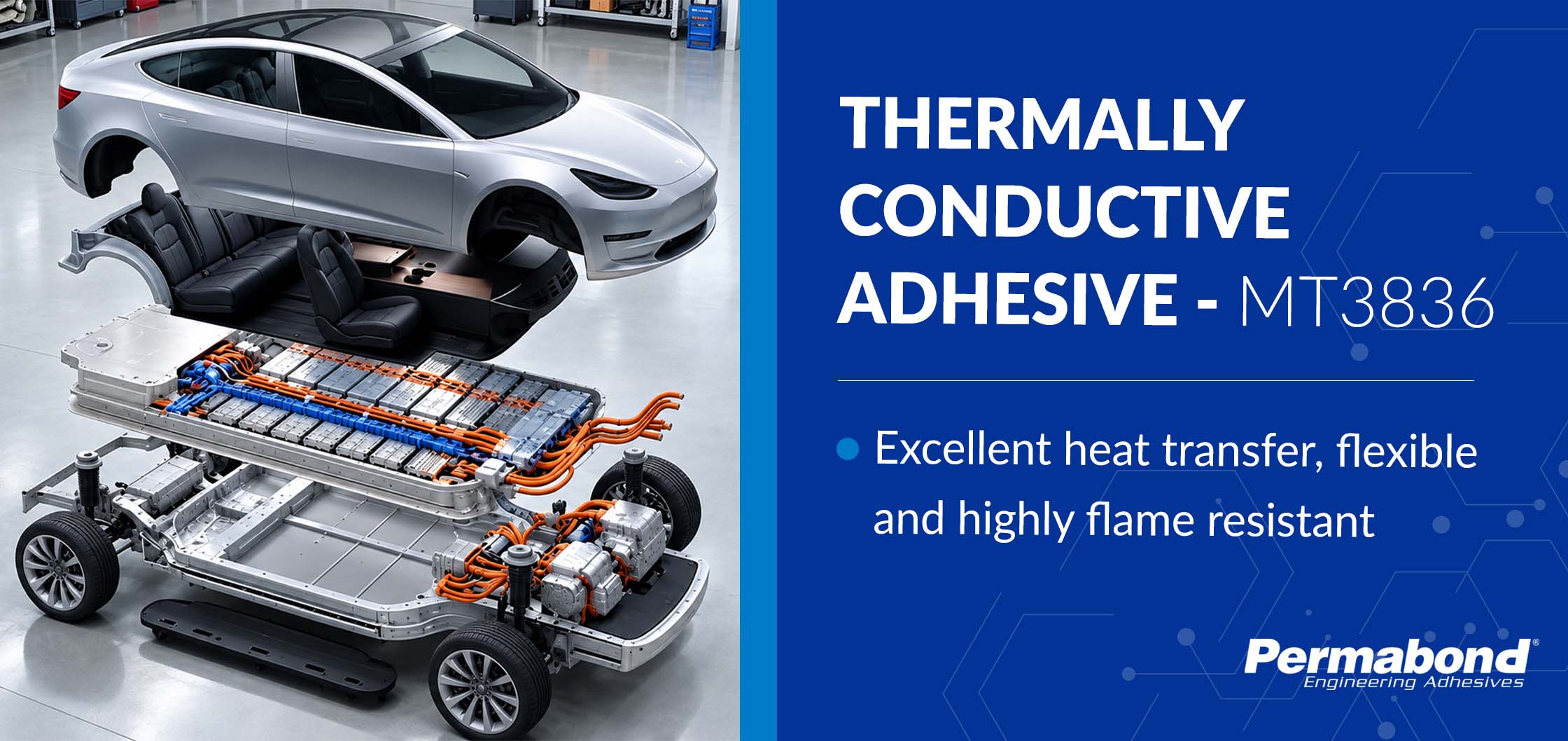
Permabond MT3836 is a flexible, thermally conductive adhesive that offers outstanding fire resistance – ideal for bonding heat sinks, batteries and more.
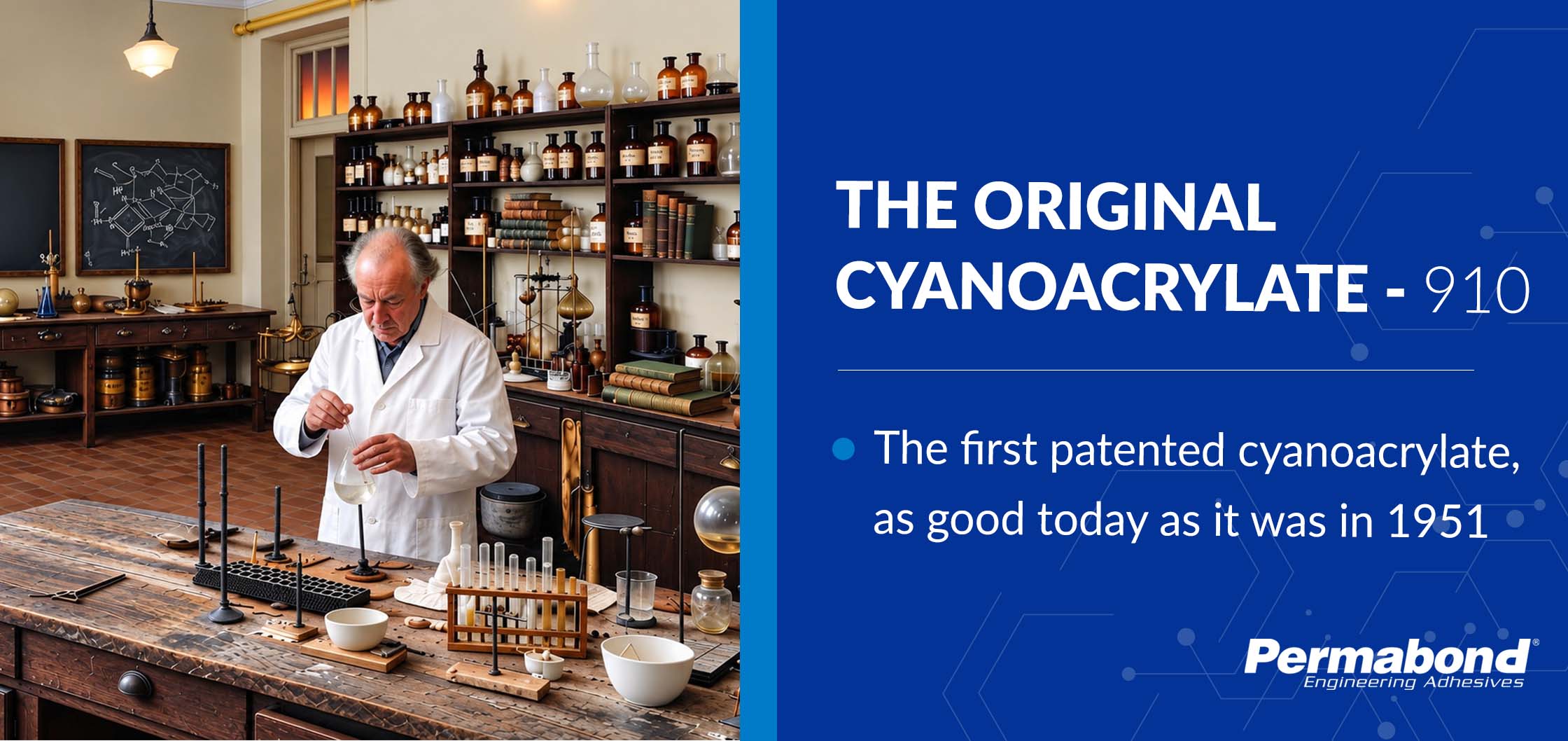
Learn all about the very first cyanoacrylate adhesive ever made. Permabond 910 is the original cyanoacrylate and its formulation remains unchanged to this day.


